Pea gravel patios and paths: how deep, what base and how much to order
Updated October 12, 2026 · Reading time: 6 min · 8 sections
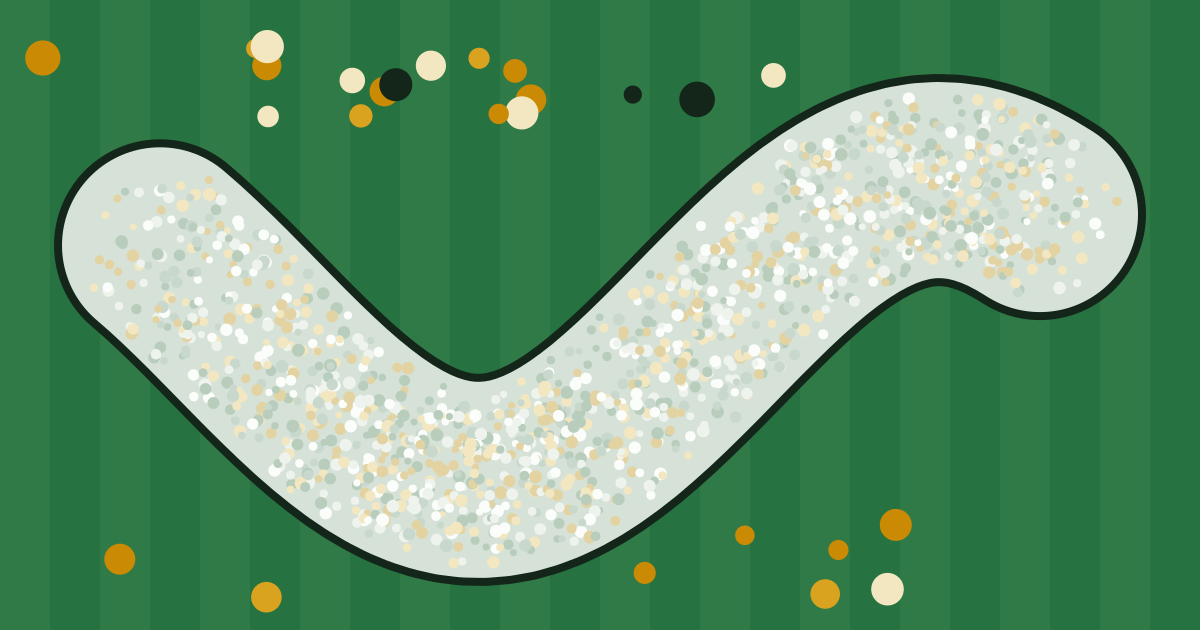
A pea gravel patio looks finished the afternoon you rake it and starts failing the first week it rains if nothing firm sits underneath. Done right it is two layers: a compacted crushed stone base and a 2 to 3 in skin of pea gravel on top.
The mistake I see most often is pea gravel poured straight onto soil. Round stones have no edges to grip, so they sink, scatter and show the dirt within a season. The base is not an extra; it is the patio.
Pea gravel patio and path: the build-up
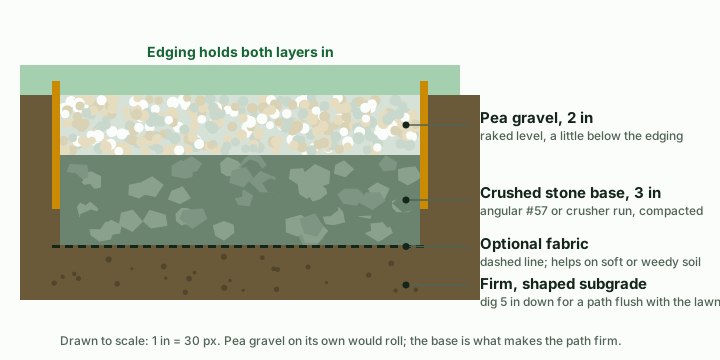
- Mark the shape and dig down the base depth plus the pea gravel depth, about 5 to 6 in for a path and 6 to 7 in for a patio.
- Shape the soil with a slight fall away from the house and compact it.
- Fit the edging first. It holds the stone in and sets the finished height.
- Spread the base in one layer, wet it lightly and compact it with a plate compactor, or a hand tamper on a small path.
- Rake the pea gravel level, keep it a little below the edging, and walk it in.
For the base use angular crushed stone, either #57 or crusher run. Crusher run packs flatter; #57 drains faster. For the stone itself, see crushed stone sizes explained.
How deep should pea gravel be?
| Use | Pea gravel | Base under it |
|---|---|---|
| Garden path | 2 in | 3 in compacted crushed stone |
| Patio or seating area | 2 to 3 in | 4 in compacted crushed stone |
| Decorative bed, no foot traffic | 2 in | Firm soil, optionally fabric |
| Driveway surface | 1 to 2 in thin dressing only | Full base, see the driveway layers guide |
Thinner than 2 in and the base shows through. Thicker than 3 in and every step sinks, which makes chairs wobble and wheelbarrows hard work. Round stone behaves like a liquid when it is deep.
A drive needs a proper build; gravel driveway layers explains it.
Fabric, grids and edging
Edging is not optional. Without it the pea gravel migrates onto the lawn and the edges thin out. Steel, stone, brick or timber all work if they are set firm.
Fabric between base and soil keeps the two apart on soft ground. Fabric between base and pea gravel is a mixed bag: it stops weeds from below, but seeds that land on the gravel still root, and a rake catches and tears it. I use it under the base on soft soil and leave it out above.
Stabilizer grids are plastic honeycomb panels that you fill with the gravel. They stop the stone from shifting and make rolling chairs, wheelchairs and wheelbarrows easier. They cost extra, and they are worth it on anything with wheels.
How much pea gravel to order
cubic yards = cubic feet ÷ 27
US tons = cubic yards × 1.42 (pea gravel, loose)
For a pea gravel patio, add 10 percent for settling and spillage on the pea gravel. For the crushed base add 20 percent, because compaction squeezes it. These are typical orders; the prices and bag sizes are up to your supplier.
| Job | Layer | Volume | US tons |
|---|---|---|---|
| Patio 10 × 10 ft | Pea gravel 3 in | 0.93 yd³ | 1.31 |
| Pea gravel, +10% | 1.02 yd³ | 1.44 | |
| Crushed base 4 in, +20% | 1.48 yd³ | 2.07 | |
| Path 30 × 3 ft | Pea gravel 2 in | 0.56 yd³ | 0.79 |
| Crushed base 3 in, +20% | 1.00 yd³ | 1.40 | |
| Patio 4 × 3 m | Pea gravel 5 cm | 0.60 m³ | 1.01 t |
| Pea gravel, +10% | 0.66 m³ | 1.11 t | |
| Crusher run base 10 cm, +20% | 1.44 m³ | 2.76 t |
For the 10 × 10 ft patio, 1.44 tons is a hair over a 1 yd³ delivery. I would order 1½ tons rather than risk running short. The metric patio needs a little over one 1 t bulk bag of pea gravel, so order two bags or ask for a loose half-tonne.
The gravel calculator does this for both layers and rounds the order the way yards sell it. Its garden path preset is the 3 in base with 2 in of pea gravel on top, and its metric patio preset is the 10 cm crusher run base with 5 cm of pea gravel; change any depth or stone to suit your job.
Measuring a curved path or a round pea gravel patio
Pace the centre line of a curved path and multiply by its average width: a 40 ft path that runs 2½ ft wide is 100 ft². A round patio is measured across the diameter, then area = π × (diameter ÷ 2)². A 12 ft circle is 113.1 ft², not 452, which is what you get if you type the diameter where a radius belongs. Measure depth in inches, never feet. Four feet of gravel instead of four inches is twelve times too much.
Mistakes that make pea gravel misbehave
- No base, or a base of pea gravel on pea gravel, so everything shifts.
- No edging, so the stone creeps into the lawn.
- Laying it deeper than 3 in, so it feels like walking on marbles.
- Skipping the fall, so water pools against the house.
- Ordering by the yard when the yard sells by the ton, or the other way round. Check which one the quote uses.
Bags or bulk?
Bags are tidy and carry easily, but you pay for a lot of packaging and count a lot of bags. Bulk is cheaper per yard and arrives on a tarp, but needs a delivery slot and a place to tip it. The break-even depends on the quote, so compare your own numbers.
Bag sizes vary, so read the label. Bags = total weight ÷ bag weight, rounded up, and the calculator counts them for any bag weight you type in kg or lb. As a made-up example, the 10 × 10 ft patio needs 1.44 US tons, about 2,880 lb, of pea gravel: in bags marked 50 lb that is 58 bags.
Keeping it right after the first season
- Rake it back toward the middle each spring; foot traffic pushes the stone out to the edges.
- Keep a few buckets of spare pea gravel to top up thin spots.
- Pull weeds when they are small, before the roots grab the fabric.
- Clear leaves with a rake or a blower on low, not a shovel that scoops stone.
This is general information; check local rules before digging, and call utility locators before any large excavation.
Common questions
How deep should pea gravel be for a patio?
Between 2 and 3 in over a compacted crushed stone base of about 4 in. Thicker than that and the surface feels loose underfoot.
Can I lay pea gravel straight onto soil?
You can, but it will sink and scatter and the soil will show through within a season. A compacted angular base under it is what keeps it firm.
Do I need landscape fabric under pea gravel?
Under the base on soft or weedy soil, it helps keep stone and soil apart. Directly under the pea gravel it often tears when you rake and does not stop weed seeds that land on top.
How much pea gravel do I need for a 10 × 10 ft patio?
At 3 in deep it is 0.93 yd³ or 1.31 US tons. With 10 percent extra, order about 1.44 tons, so 1½ tons from a yard that sells by the ton.