Gravel driveway layers: stone sizes, depths and tons per layer
Updated October 12, 2026 · Reading time: 6 min · 9 sections
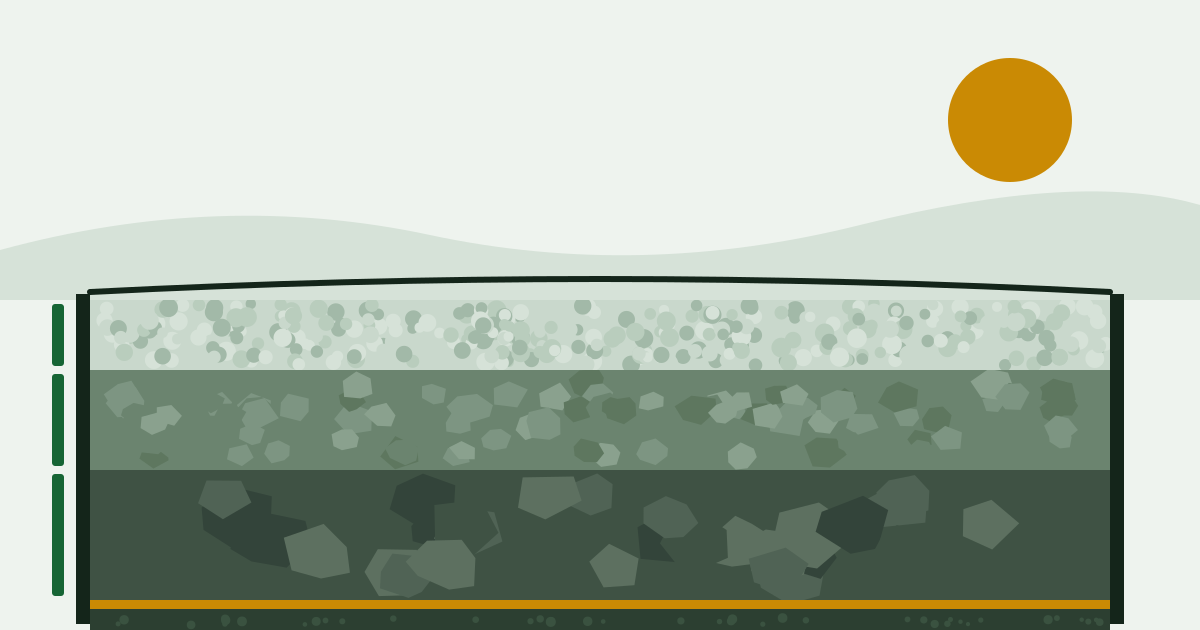
Gravel driveway layers decide whether a drive stays flat for a decade or ruts after the first wet spring: three stone sizes, each with its own job, spread and compacted one at a time. This is how I build them, how deep each one goes and how many tons each layer adds to the order.
A 60 ft drive ordered as one 9 in pile of #57 looks perfect until the first loaded truck. Clean, same-size stone has nothing small to lock against, so it rolls and spreads under the tires. Big stone below, medium in the middle and small on top is what turns a pile into a surface.
Gravel driveway layers, bottom to top
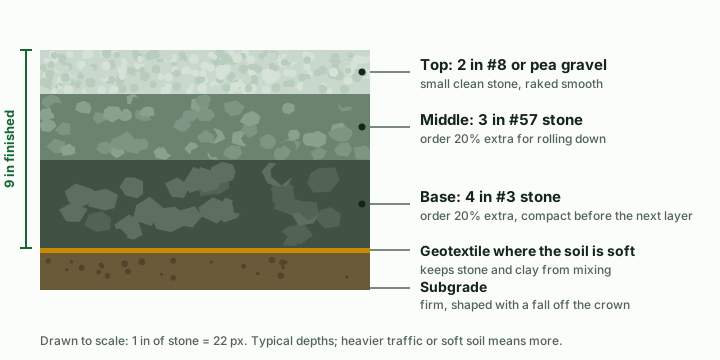
| Layer | Stone | Finished depth | What it does |
|---|---|---|---|
| Base | #3 (or #4) clean crushed stone | 3 to 4 in | Carries the wheel load down to the soil and lets water through |
| Middle | #57, or crusher run | 2 to 3 in | Fills the gaps in the base and gives the top layer a firm bed |
| Top | #8, or a thin pea gravel dressing | 1 to 2 in | The surface you drive on and rake; the only layer you will ever top up |
If you would rather buy one material, a dense-graded driving surface aggregate does the job: Penn State's bulletin places it 8 in loose and rolls it to 6 in. The three-layer build costs more to haul but drains better, which is why I still prefer it where the ground stays wet.
Dig first: the subgrade does half the work
Stone only spreads a load; the soil underneath still carries it. Spend your effort here.
- Strip sod and topsoil. Organic soil squeezes and rots, and the drive follows it down.
- Excavate to the full build-up depth, plus a little for the crown.
- Shape the subgrade with the same fall you want on the surface, then compact it until a heavy boot barely marks it.
- Lay geotextile over soft or clay-heavy soil, seams overlapped, so stone and mud stay apart.
- Spread the base and compact it. Spread the middle layer and compact it. Spread the top, rake it level and make a last pass.
How deep: depths, lifts and the 6 in rule
Ohio DOT limits a compacted lift of crushed aggregate to 6 in. Thicker bases go down in lifts, each compacted before the next. These are the depths I start from for gravel driveway layers, then adjust to the soil and the traffic:
| Use | Base | Middle | Top | Total |
|---|---|---|---|---|
| Cars only, firm ground | 3 in | 2 in | 1 in | 6 in |
| Typical family drive | 4 in | 3 in | 2 in | 9 in |
| Soft ground or regular heavy trucks | 6 in or more, in two lifts | 3 in | 2 in | 11 in or more |
For the last row, add fabric and get a contractor to look at the site. Depth alone will not fix soft ground.
Crown, drainage and the fall of water
Water sitting on a drive softens the subgrade from above. Penn State asks for a crown or cross-slope of ½ to ¾ in per foot on gravel roads. On a 12 ft drive that is 6 ft each way, so 3 to 4½ in higher at the centre line. That is a lot for a driveway you park on, so I stay near the low end, or tilt the whole drive one way to a ditch when the site allows. Either way, depth varies across the width, so use the average when you calculate.
Order loose, not compacted
A plate compactor or roller squeezes crushed base by 20 to 33 percent. Penn State's example is 8 in loose becoming 6 in, a factor of 1⅓ on volume, and its shortcut for a driving surface is tons = length (ft) × width (ft) × 0.04 for 8 in loose, or × 0.03 for 6 in loose.
Two views of the same stone agree. Ohio DOT converts a compacted yard of crushed stone at 3,800 lb, or 1.9 tons. A loose yard of clean stone is about 1.4 tons, and 1.4 × 1⅓ = 1.87. So order the loose depth, weigh it at the loose density, and do not apply both corrections.
Worked example: a 60 × 12 ft drive in three layers
Area: 60 × 12 = 720 ft². Each layer is area × depth ÷ 12 for cubic feet, plus the allowance, ÷ 27 for yards, × tons per yard. I use 1,660 kg/m³ (about 1.40 tons per yard) for clean stone and 1,680 kg/m³ for pea gravel.
| Layer | Finished depth | Allowance | Order (yd³) | US tons |
|---|---|---|---|---|
| Base, #3 | 4 in | +20% | 10.67 | 14.92 |
| Middle, #57 | 3 in | +20% | 8.00 | 11.19 |
| Top, pea or #8 | 2 in | none | 4.44 | 6.29 |
| Total | 23.11 | 32.41 |
The total uses unrounded layer figures. At 14 tons per load that is 2.3, so three loads (four if each stone comes on its own truck); check what your hauler's trucks really carry. At a made-up $38 per ton the stone comes to about $1,231. The gravel calculator builds this exact stack layer by layer (start from its three-layer driveway preset) and does the rounding for you.
The same gravel driveway layers in metres: a 15 × 3 m drive
Area 45 m². Sub-base of crusher run (1,920 kg/m³) at 15 cm with a 25% allowance: 45 × 0.15 × 1.25 = 8.44 m³, which is 16.2 t. Pea gravel top at 5 cm: 45 × 0.05 = 2.25 m³, which is 3.78 t, so four 1 t bulk bags. Total about 10.7 m³ and 20 t.
Mistakes that cost a driveway
- Putting the whole depth down in one lift. The bottom never compacts.
- Using round pea gravel as a base. It rolls; base layers need angular stone.
- Ordering the compacted volume. You will be short by about a fifth to a third.
- Skipping the crown, so water sits on the surface.
- Reading a price per ton as a price per tonne: short tons and metric tonnes differ by about 10%.
When I would hand it to a contractor
Steep slopes, a culvert or ditch crossing, soft ground, or regular heavy deliveries are where a general guide runs out. This is general information, not engineering advice, so follow local rules and let someone on site decide. For the stone itself, read crushed stone sizes explained. If you want a decorative top, pea gravel patios and paths covers how thin it can go.
Common questions
How deep should a gravel driveway be?
For cars on firm ground I start at 6 in of finished stone in three layers, and 9 in is typical for a family drive. Soft soil or heavy trucks need more, laid in lifts of no more than about 6 in compacted.
How many tons of gravel do I need for a driveway?
Multiply area by depth to get cubic feet, add 20 to 33 percent for compaction on base layers, divide by 27 for yards and multiply by about 1.4 to 1.6 tons per yard. A 60 × 12 ft drive in three layers works out to about 32 tons.
Do I need landscape fabric under a gravel driveway?
On soft, clay-rich or wet soil, yes: geotextile keeps stone and soil from mixing. On firm, well-drained ground a good compacted base can do without it.
Can I use only one type of stone?
Yes. A dense-graded driving surface aggregate with fines packs hard; Penn State places it 8 in loose and compacts it to 6 in. Clean single-size stone alone will not lock.
How much does gravel shrink when compacted?
Crushed base loses roughly 20 to 33 percent of its loose depth under a plate or roller, so 8 in loose becomes about 6 in.