Crushed stone sizes explained: #3, #57, #8, crusher run and pea gravel
Updated October 12, 2026 · Reading time: 5 min · 7 sections
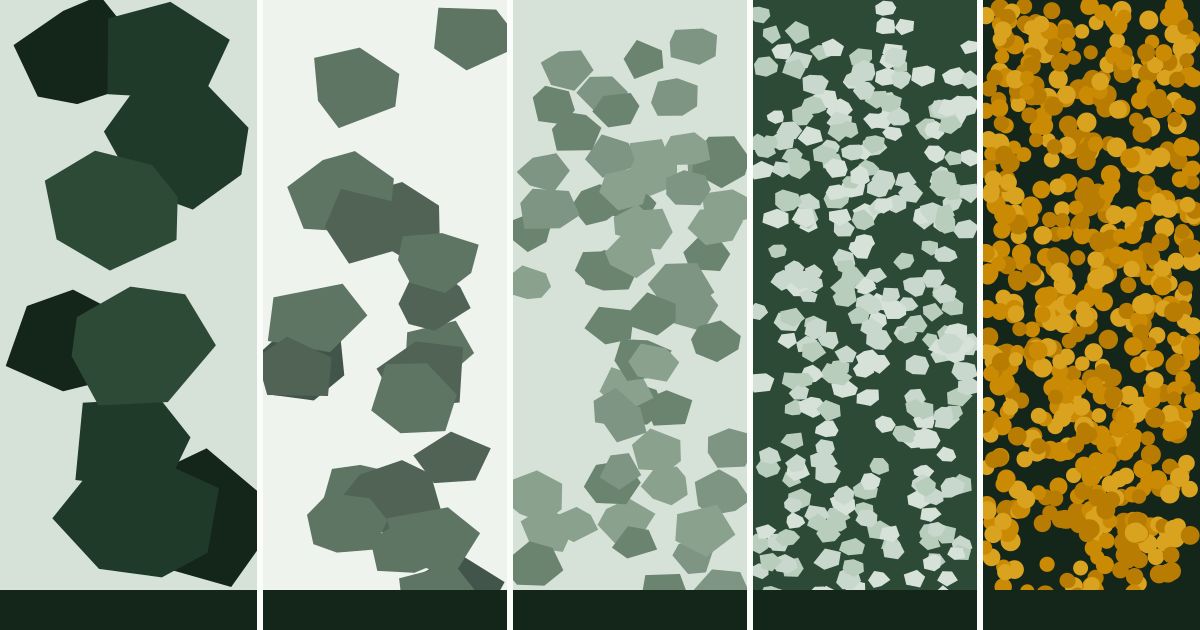
Crushed stone sizes are named by sieve number, and the one rule that trips every beginner is that the bigger the number, the smaller the stone. #3 is the chunky one, #57 is the all-rounder and #8 is close to chips.
Three separate choices hide inside a stone order: how big the pieces are (the number), whether fines are mixed in (washed or not), and whether the edges are sharp or worn round. Settle those and the weight per yard, the job it suits and the price per ton all follow.
Crushed stone sizes by number
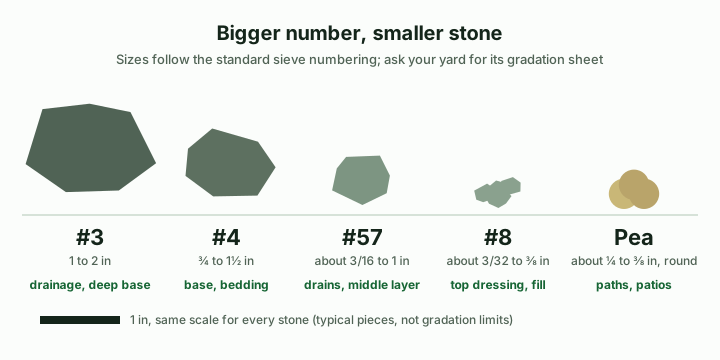
The numbers come from the standard size tables highway agencies use (ASTM D448 and AASHTO M 43). Each number is a band between a top sieve and a bottom sieve, not a single size.
| Name | Size band | Where I use it |
|---|---|---|
| #3 | 1 to 2 in | Deep drainage fill, driveway base on soft sites |
| #4 | ¾ to 1½ in | Driveway base, bedding, large drainage voids |
| #57 | about 3/16 to 1 in (down to the #4 sieve) | Drains, French drains, middle layer, behind walls |
| #8 | about 3/32 to ⅜ in (down to the #8 sieve) | Top dressing, fill between larger stone, light-duty paths |
| Pea gravel | about ¼ to ⅜ in, rounded | Paths, patios and decorative areas |
Clean stone or stone with fines
Washed stone like #3, #57 and #8 has the dust removed, so water runs straight through and the pieces never pack tight. That makes it the right stone wherever water has to move.
Crusher run, quarry process (QP), dense-graded aggregate (DGA) and driving surface aggregate (DSA) keep the fines. Penn State puts the fines passing the #200 sieve in DSA at 11 to 15 percent and asks for compaction to at least 95 percent of maximum dry density. Those fines glue the stone into a hard skin. My rule: clean stone where the water goes, graded stone where the traffic goes.
Angular or round: why pea gravel is a different animal
Crushed stone has fractured faces that grab each other and carry a load. River rock and pea gravel are worn smooth by water, so the pieces roll over each other. That is wonderful under bare feet and hopeless as a base, which is why pea gravel always goes on top of angular stone, never under it. The pea gravel patio and path guide shows the build.
Which stone goes where
| Job | Stone | Why |
|---|---|---|
| Drainage trench, behind a retaining wall, dry well | #57 (or #3), washed, wrapped in fabric | Open voids move water; fabric keeps soil out |
| Driveway base | #3 or #4, or crusher run | Big pieces spread the load |
| Driveway middle layer | #57 or crusher run | Fills the base and gives a firm bed |
| Driveway surface | #8, DSA, or a thin pea gravel dressing | Smooth to drive and rake |
| Under a shed or patio | Crusher run, QP or DGA, compacted | Fines let it pack flat |
| Bank or ditch lining | Riprap, 4 to 24 in | Heavy angular stone stays put |
| Decorative beds | River rock, marble chips, lava rock | Color and texture, no load |
Crushed stone sizes only make sense against a job, so pick the job first. See gravel driveway layers for how #3, #57 and #8 stack into one build.
What a yard of each one weighs
Stone is sold by the ton in most yards and by the yard in others, so the conversion matters. These are the loose, as-delivered figures I use. They move with moisture and grain size, so quote a range and ask your yard for theirs.
| Stone | Tons per yd³ (range) | Default kg/m³ | Tons for 100 ft² at 3 in |
|---|---|---|---|
| Pea gravel | 1.25 to 1.5 (1.42) | 1,680 | 1.31 |
| Clean crushed stone: #3, #57, #8 | 1.4 to 1.7 (1.40) | 1,660 | 1.30 |
| River rock, 1 to 3 in | 1.3 to 1.6 (1.39) | 1,650 | 1.29 |
| Crusher run, QP, DGA | 1.5 to 1.7 (1.62) | 1,920 | 1.50 |
| Pit-run bank gravel | 1.4 to 1.7 (1.63) | 1,940 | 1.51 |
| Riprap, 4 to 24 in | 1.7 to 2.0 (1.85) | 2,190 | not laid this thin |
Figures in brackets are the defaults I calculate with. Lava rock is the outlier at roughly half the weight, so never reuse a "tons per yard" figure from another stone.
Worked example: a drainage trench 50 ft long, 1 ft wide and 18 in deep is 75 ft³, or 2.78 yd³. In #57 at 1.40 tons per yard that is 3.89 tons. The same trench filled with crusher run at 1.62 would weigh about 4.5 tons and would drain poorly, because the fines clog it. Same volume, different stone, different truck.
What to ask the yard before you order
A number alone is not an order. When I call a quarry or landscape supplier I settle five things, in this order:
- The job, not just the number: "base for a drive" gets a better answer than "#3".
- Washed or with fines, because that decides drainage and whether it packs.
- Their tons per cubic yard for that exact pile today, since moisture changes it.
- Whether they sell it by the ton or the yard, and the minimum load.
- What their truck carries, so you know how many trips and whether the drive can take the weight.
Write the answers down and feed them into the calculator instead of trusting a default. Two minutes on the phone beats a pile that is a ton short or a base that will not drain.
Names change at the county line
The crushed stone sizes are widely understood, but yards do not all agree on what a name means. Crusher run is called QP, road base, DGA, subbase or, in some regions, #411, and the exact gradation differs by state and quarry. Ask the yard for its gradation sheet and for its tons per yard, then type that density into the gravel calculator. Do not assume that a #57 from one quarry weighs what a #57 from another does.
Common questions
What is #57 stone used for?
It is the all-round clean stone: drainage trenches, French drains, backfill behind walls and the middle layer of a driveway. Its pieces run from about 1 in down to roughly 3/16 in.
Is crusher run the same as #57 stone?
No. #57 is washed and has no fines, so it drains and does not pack. Crusher run includes stone dust, so it compacts to a firm layer but drains poorly.
What size is #3 stone?
It runs from about 1 to 2 in. It is the big stone I use for deep fill and for driveway bases on soft ground.
Is pea gravel crushed stone?
No. Pea gravel is naturally rounded and about 1/4 to 3/8 in, so it rolls rather than locks. Use it as a surface over angular stone, never as the base.